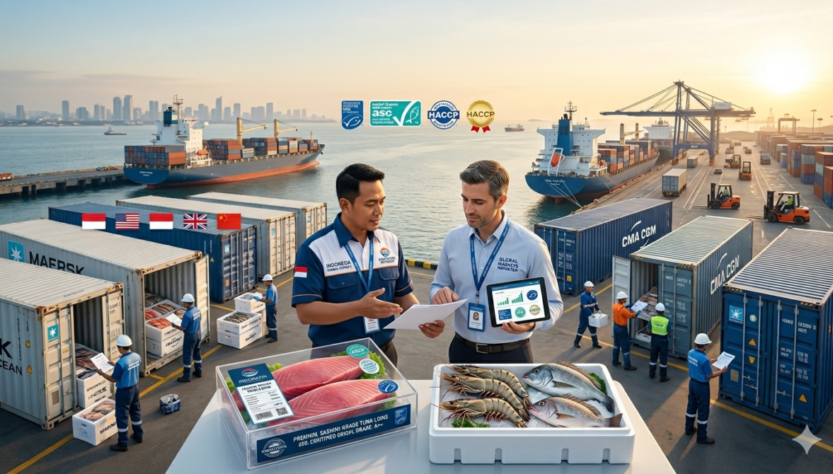
Global seafood buyers are no longer looking only for attractive pricing. They are looking for consistency, food safety, product variety, export readiness, and a partner who understands how the international seafood trade works. In this environment, choosing the right Seafood Exporter can influence everything from menu planning and retail availability to cold-chain performance and long-term buyer confidence.
Indonesia has become one of the most important seafood sourcing destinations in Asia, supported by rich marine resources, diverse species, and a growing processing industry. For importers, wholesalers, hotels, restaurants, and food-service companies, working with a reliable Indonesian seafood export company can provide access to a broad range of fresh and frozen seafood products tailored to global market needs.
Global Seafood Demand Is Still Strong
The seafood industry remains a major part of the global food trade. FAO estimated that world exports of fishery and aquaculture products reached around USD 171 billion in 2024, indicating that seafood remains a high-value international commodity even in a softer trade year. Indonesia also recorded positive export momentum. The Ministry of Marine Affairs and Fisheries reported that Indonesia’s fishery exports reached USD 5.95 billion in 2024, up 5.7% compared with the previous year.
This growth matters because global buyers are becoming more selective. They need suppliers who can manage documentation, product handling, freezing standards, and quality control from source to shipment. A Seafood Exporter that meets these expectations offers buyers more than just products. It gives them reliability.
Also read Why the Best Raja Ampat Liveaboard Experience Keeps the World’s Divers Coming Back
Why Indonesia Is a Strategic Seafood Source
Indonesia’s leading fishery export commodities in 2024 included shrimp at USD 1.68 billion, tuna, skipjack, and bonito at USD 1.03 billion, and squid, cuttlefish, and octopus at USD 874.12 million. These categories are especially relevant for buyers seeking seafood export products with steady demand across restaurants, retail freezers, and wholesale markets.
For a seafood distributor or seafood trader, Indonesia offers an attractive combination of species diversity and processing capability. Products such as tuna, shrimp, milkfish, grouper, squid, cuttlefish, and octopus can serve different market segments, from premium dining to large-scale frozen food distribution.
What Buyers Expect from a Seafood Supplier Today
A modern seafood supplier is expected to do more than send a catalogue. International buyers want clarity on product forms, freezing methods, sizing, packing, storage, and export documents. They also want confidence that the supplier can respond to market needs quickly and consistently.
This is where a professional seafood supplier company becomes valuable. The right supplier can help buyers choose suitable forms, such as whole-round fish, gilled and gutted fish, fillets, steaks, loins, blocks, IQF, or semi-IQF products. These details are important because every market has different expectations. A restaurant group may prioritise portion control and texture, while a distributor may focus on volume, shelf life, and packaging efficiency.
The Importance of Frozen Seafood Products
Frozen seafood products play a key role in global trade because they help maintain availability, reduce spoilage, and support long-distance distribution. For buyers importing from Asia, freezing quality directly affects product value. Poor freezing can damage texture, appearance, and shelf stability, while proper freezing helps preserve seafood for international transport.
A frozen seafood exporter must therefore pay attention to processing speed, cold storage, hygiene, and temperature control. CV Anugerah Bahari Mandiri, also known as AB Mandiri, states that its products are freshly caught, immediately frozen using an ABF machine at -40°C, and then stored at -20°C. Its product range includes pelagic fish, tuna, milkfish, demersal fish, shrimp, and cephalopods, with IQF, semi-IQF, and block-frozen options.
AB Mandiri and Indonesia’s Export Potential
Based in Makassar, South Sulawesi, CV Anugerah Bahari Mandiri has been involved in the fishery products industry since 1997 and has developed export experience in more than 10 countries, including the United States, China, South Korea, and Singapore. The company also highlights HACCP, GMP, quality control, metal detection, and cold storage as part of its processing approach.
For buyers searching for seafood supplier options in Indonesia, AB Mandiri represents the type of local partner that connects Indonesia’s marine potential with international buyers’ requirements. Its location in Makassar is also important. South Sulawesi has long been connected to fisheries, trading routes, and marine supply chains, making it a strategic base for seafood sourcing and export operations.
Product Variety Supports Different Market Needs
One reason buyers look for a strong Seafood Exporter is product flexibility. A single importer may need several categories, such as tuna loins, frozen squid, shrimp, milkfish, or grouper, depending on seasonal demand and customer preference. Having access to multiple fishery product categories through one supplier can simplify procurement and reduce communication gaps.
AB Mandiri’s product portfolio covers several seafood categories, including ribbon fish, flying fish, skipjack tuna, albacore tuna, yellowfin tuna, bigeye tuna, milkfish, grouper, parrot fish, vannamei shrimp, black tiger shrimp, squid, cuttlefish, softbone cuttlefish, arrow squid, and octopus. For a seafood trader or seafood distributor, this variety can support more flexible buying strategies across retail, food service, and wholesale channels.
Quality Control Builds Long-Term Trust
In the seafood trade, trust is built through repeat performance. Buyers want products that arrive as ordered, with the expected size, form, quality, and documentation. A strong quality-control system reduces the risk of disputes, rejected shipments, and inconsistent customer experiences.
This is especially important as the seafood trade becomes more transparent and competitive. Importers are not only comparing prices. They are also evaluating supplier communication, traceability, certifications, processing standards, and cold-chain discipline. Companies that can demonstrate these capabilities are more likely to become long-term partners rather than one-time vendors.
Choosing the Right Seafood Export Partner
Choosing the right seafood export partner is ultimately about reducing risk while increasing supply confidence. The best partner is one that understands both the product and the buyer’s market. It should offer clear information, reliable freezing processes, export-ready documentation, and a product range that supports commercial demand.
For global buyers, Indonesia remains a valuable sourcing destination for seafood exports, particularly frozen seafood that can serve international distribution channels. With companies such as CV Anugerah Bahari Mandiri contributing to the country’s seafood export capacity, buyers can tap into a stronger supply chain built on product diversity, processing expertise, and export knowledge.
As demand continues to evolve, seafood businesses that choose the right Indonesian partner will be better positioned to serve customers with quality, consistency, and confidence.