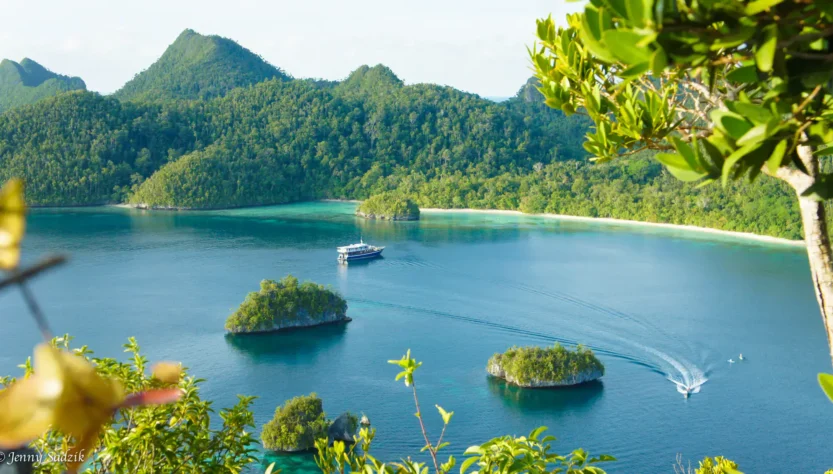
For divers in Canada, the United States, and France seeking an extraordinary underwater adventure, the best Raja Ampat liveaboard offers an experience that simply cannot be replicated anywhere else on Earth — a once-in-a-lifetime immersion into the planet’s most biodiverse marine ecosystem.
1,400+
Fish Species
600+
Coral Species
1,500+
Islands & Cays
27–31°C
Water Temp
The Crown Jewel of the Coral Triangle
Tucked in the remote far east of the Indonesian archipelago, Raja Ampat sits at the very heart of the Coral Triangle, a region scientists refer to as the Amazon of the ocean. This extraordinary destination encompasses four main islands, Misool, Salawati, Batanta, and Waigeo, along with more than 1,500 smaller islands, each surrounded by reef systems of staggering complexity and colour.
What sets Raja Ampat apart from every other dive destination on the planet is not any single reef or species, but the sheer, relentless density of life at every depth, in every direction. Reef walls draped in soft corals, schools of thousands of fish, and encounters with creatures found nowhere else in the ocean await beneath the surface. For anyone passionate about Raja Ampat diving, this is the ultimate arena.
“At Cape Kri, marine biologist Dr. Gerard Allen recorded 347 fish species in a single dive a world record that still stands today.”
Why Divers from Around the World Make the Journey
Travellers flying in from Toronto, Paris, Los Angeles, Montréal, or New York share a common realisation the moment they descend into Raja Ampat’s waters: nothing in the Atlantic or the Mediterranean has prepared them for this. The sheer biomass of the walls of bumphead parrotfish, the manta ray cleaning stations, and the walking sharks creates a sensory experience that transforms how divers think about the ocean.
The accessibility of a well-run best Raja Ampat liveaboard itinerary is what makes this wilderness approachable. Rather than island-hopping by day boat and losing hours to travel, guests sleep directly above the reef, ready to slip beneath the surface at dawn when marine life is at its most active and visibility is pristine.
Key Dive Areas That Define a Raja Ampat Liveaboard Route
Wayag
Iconic mushroom-shaped limestone karsts rising from turquoise waters. A must-see on any Raja Ampat liveaboard route, equally famous above and below the surface.
Dampier Strait
Home to world-record fish diversity. Cape Kri and Manta Sandy are headline dive sites, offering both pelagic encounters and dense reef life.
North Raja Ampat
Dramatic seascapes around Kawe islands. Regular manta ray sightings at Eagle Rock make this a favourite for wide-angle photographers.
Misool
Gorgonian fields, four species of pygmy seahorses, Magic Mountain manta station, and grey reef sharks. Macro and wide-angle heaven in South Raja Ampat.
The Liveaboard Advantage: Why a Boat Trip Is the Best Way to Explore
A Raja Ampat boat tour from a land-based resort covers a fraction of what a liveaboard itinerary can achieve. With a vessel as your floating base, guides move the entire operation to where conditions are optimal chasing tidal windows, manta aggregations, and whale shark sightings with a flexibility that day trippers simply cannot match.
The best Raja Ampat liveaboard operators design itineraries around the seasons, leveraging the October-to-April prime window to access the most remote and productive dive sites. Multiple dives per day become effortless when the boat anchors directly over the reef overnight, and surface intervals are spent watching sunsets over limestone pinnacles rather than enduring bumpy speedboat transfers.
A dedicated Raja Ampat diving trip aboard a purpose-built vessel also offers a dive deck with infrastructure, camera rinse stations, well-organised gear storage, and experienced local divemasters who know every current, every cleaning station, and every nudibranch hotspot in the region.
What a Diving Cruise in Indonesia Offers Beyond the Reef
Indonesia is the world’s largest archipelago, and the epicentre of marine biodiversity, and a diving cruise through Raja Ampat places guests at the very nucleus of that abundance. But the experience extends well beyond scuba diving. Non-divers and snorkellers find the shallow lagoons of Misool and Wayag every bit as spectacular as the deep reef walls. Local village visits, kayaking through mangroves, and birdwatching for Raja Ampat’s endemic birds of paradise round out the above-water programme.
The remoteness of the destination reached via the gateway city of Sorong in West Papua ensures a genuine sense of expedition. Arriving guests leave behind connectivity and routine and enter a rhythm dictated entirely by tides, currents, and light.
Wallacea Dive Cruise: Expert-Led Exploration Since 2010
With more than 15 years of dedicated experience diving Raja Ampat’s waters, Wallacea Dive Cruise operates two premium vessels, the Ambai and the Seahorse, each built specifically for extended dive cruises in Indonesian waters. The team of experienced divemasters conducts current checks before every dive, ensuring guests are briefed on up-to-the-minute conditions at each site.
A liveaboard dive trip with Wallacea runs for 9 to 12 nights, giving guests the time and range to cover the full breadth of Raja Ampat’s dive regions from the fish-dense straits of the north to the photogenic macro gardens of Misool in the south. Itineraries are carefully sequenced to make the most of prevailing currents and seasonal wildlife movements.
For travellers seeking luxury liveaboard diving, Wallacea’s vessels offer comfortable en-suite cabins, expert guiding, all meals, and a warm return-guest programme that rewards loyalty with meaningful discounts. The operation is rated 5.0 based on 261 verified guest reviews, reflecting the consistency and care brought to every departure.
When to Go: Planning Your Raja Ampat Dive Trip
The prime diving season runs from October through April, when northeast trade winds bring calm seas and clear water to the main dive regions. Water temperatures remain steady between 27°C and 31°C (80–88°F) year-round, making multiple daily dives comfortable without a heavy wetsuit.
Occasional plankton blooms can reduce horizontal visibility, but experienced guides at Wallacea treat these conditions as an opportunity: dense plankton concentrations reliably attract manta rays, whale sharks, and other filter feeders, turning a reduced-visibility dive into one of the most memorable of a guest’s career.
Guests flying from Canada, France, or the United States typically route through Bali (Denpasar) or Jakarta before connecting to Sorong, where Wallacea cruises embark. The journey is long, but every diver who has made it will confirm it is thoroughly worth the effort.
Frequently Asked Questions
Fly to Bali or Jakarta, then connect to Sorong in West Papua, the main embarkation point. Total travel time from North America or Europe is typically 24 to 30 hours, including connections.
Many sites suit Open Water certified divers, though some experience strong currents requiring Advanced certification. Wallacea’s divemasters brief guests thoroughly before every dive and tailor site selection to the group’s skill level.
A minimum Open Water Diver certification is required. Advanced Open Water is strongly recommended, as some of Raja Ampat’s most spectacular dive sites involve moderate currents and depths beyond 18 metres.
Wallacea brings 15-plus years of local diving expertise, a 5.0-rated guest experience, two purpose-built vessels, and a returning guest programme. Their guides’ deep knowledge of the site consistently elevates every dive to an exceptional level.
Expect manta rays, wobbegong and walking sharks, pygmy seahorses, nudibranchs, reef sharks, bumphead parrotfish, and extraordinary coral gardens. Whale shark sightings are also possible during plankton bloom periods.